We built the systems. Now we install them in your business.
Front Line Capital Advisory is the consulting division of Front Line Capital. Everything we've built to transform our portfolio companies — the dashboards, the financial frameworks, the operational systems — is available to construction businesses that want to grow, prepare for sale, or simply run better.

Julia Belza leads Front Line Capital Advisory.
Julia is the operating brain of Front Line Capital' consulting arm. With an MBA and a track record spanning financial systems, operational transformation, and post-acquisition integration, she is the person who gets embedded with companies and makes them measurably better — fast.
When Front Line Capital acquires a company, Julia is in the door within days. She builds the dashboards, restructures the reporting, designs the org, and installs the processes. She's done it repeatedly and systematically — and that same methodology is available to businesses that aren't acquisition targets but need the same results.
Julia is also a featured speaker at major construction industry conferences across North America — CONEXPO, AGC, NDA, and more — where she addresses business owners on financial readiness and operational transformation.
Frank's Drilling & Blasting — ERP in 3 Weeks
Frank's Drilling & Blasting is an Ontario-based drilling and blasting contractor serving quarry operators, municipalities, and civil construction projects across Eastern Ontario. When Front Line Capital completed the acquisition, the business was running almost entirely on paper — timesheets handwritten, job costs untracked, compliance documentation scattered.
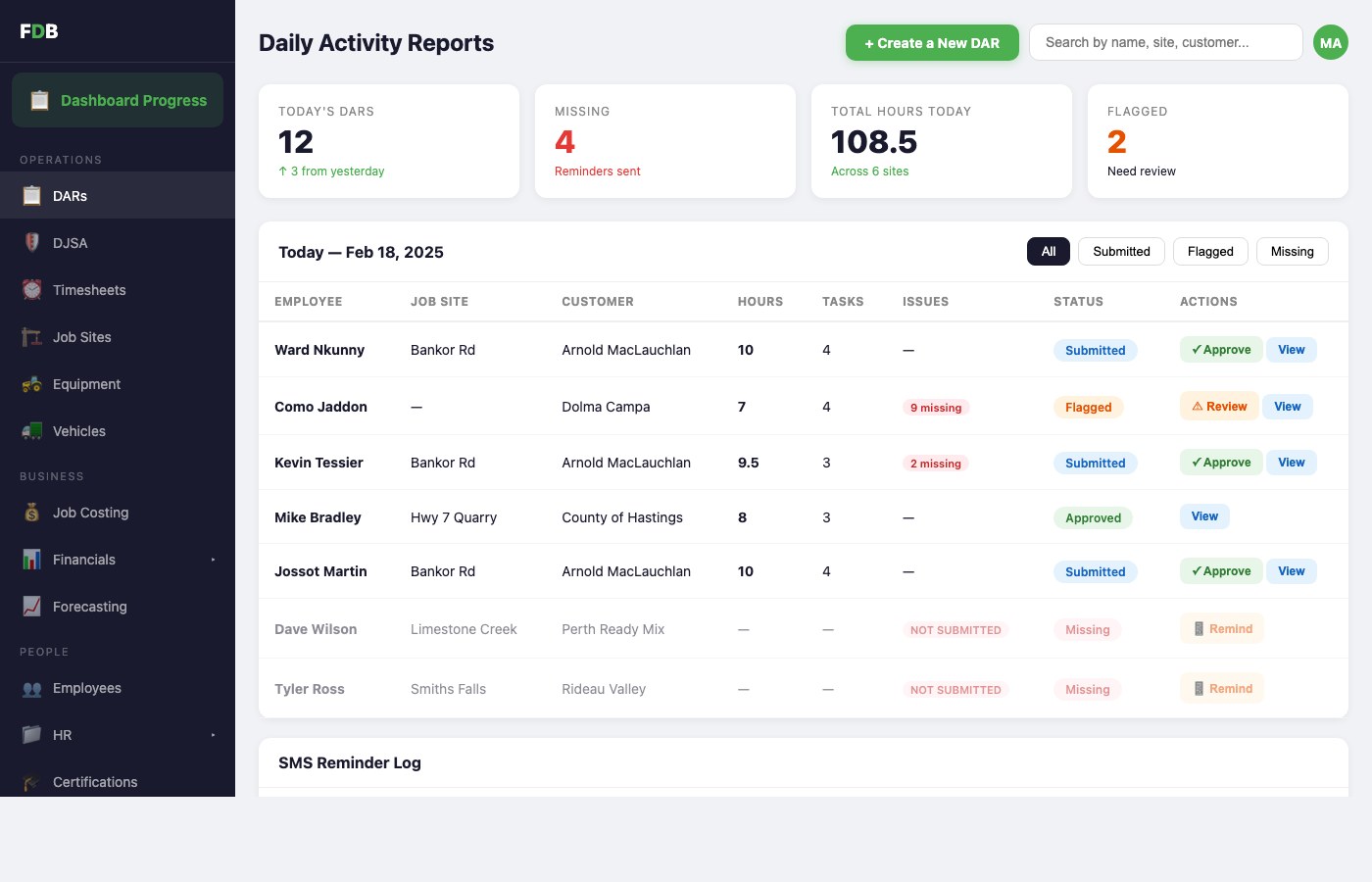
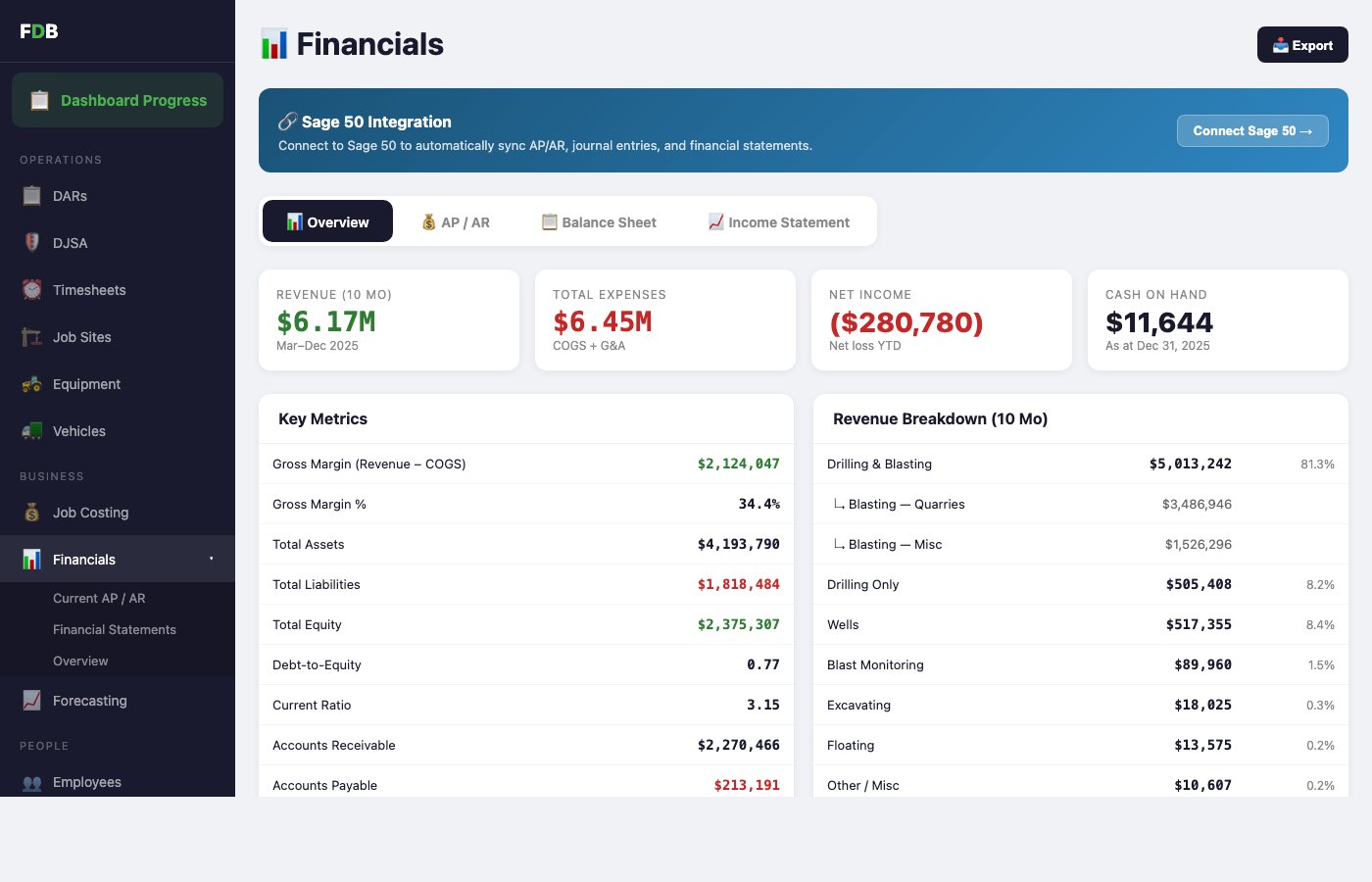
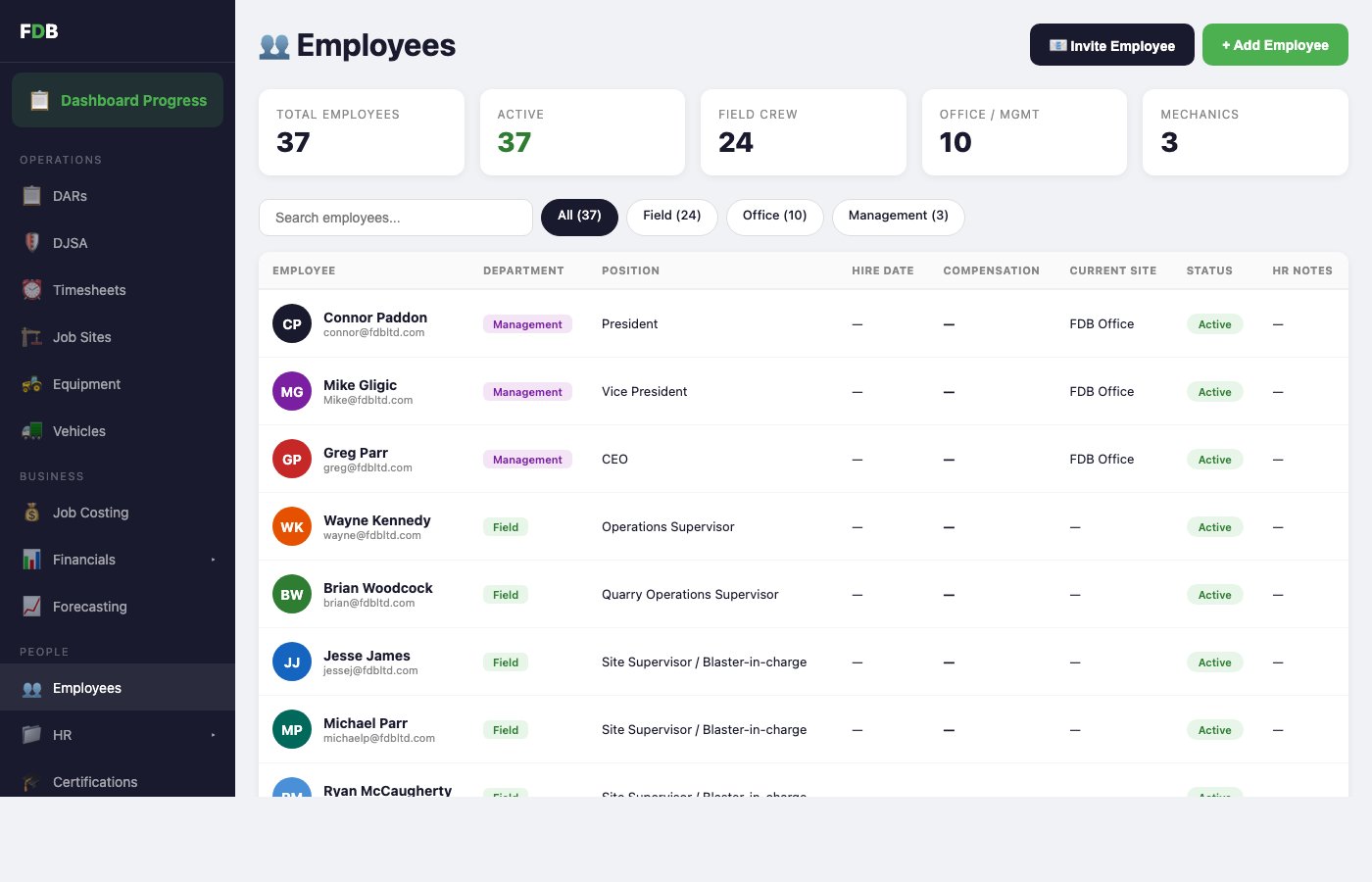
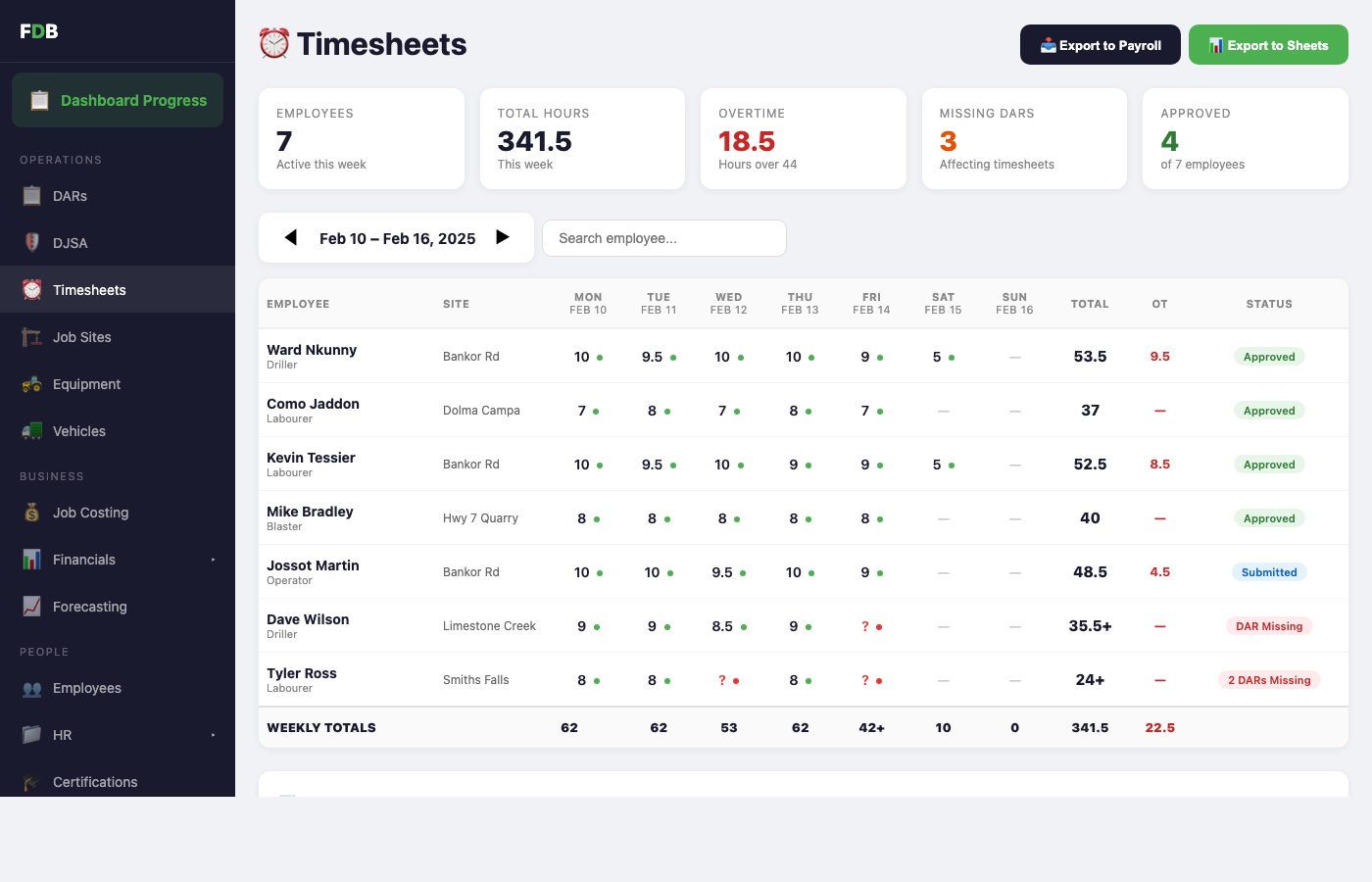
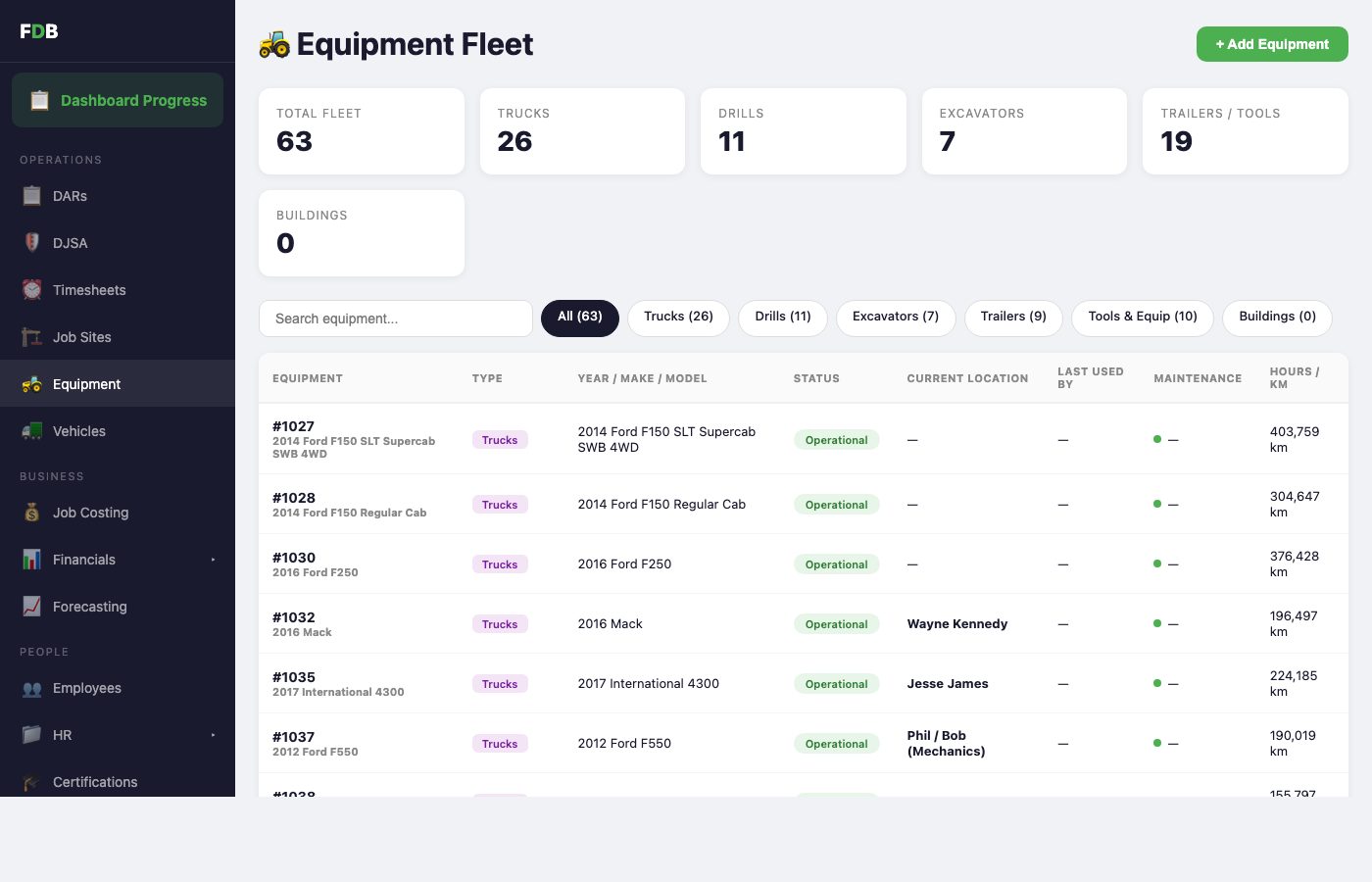
Within 3 weeks of closing, Julia had designed and deployed a fully functional ERP system built specifically for the business — covering daily reporting, job costing, employee management, equipment tracking, and financial dashboards. Not off-the-shelf. Not a template. Built for how Frank's actually operates.
What Changed After Go-Live
Before the ERP, supervisors estimated hours, costs, and job progress from memory. After implementation, every site supervisor submits a Digital Activity Report daily — hours worked, tasks completed, issues flagged. Management sees the full picture by 6 PM every day. No more week-old surprises. Decisions happen when they can still make a difference.
Drilling and blasting equipment is expensive and the failure modes are unforgiving. The ERP tracks every piece of equipment — service history, mileage, inspection schedules, certification expiry. Maintenance is now planned, not reactive. The system flags upcoming service windows before equipment goes down on a job site 2 hours from the shop.
This one changed the culture. Once job costing was accurate — real labour hours, real equipment costs, real materials — management could see exactly which crews came in under budget on a job. For the first time, the business could credibly reward that performance.
The bonus model is simple: when a crew completes a job under the estimated cost, a percentage of the savings flows back to the crew. No ambiguity, no discretion, no favouritism — the numbers are in the system. Crews that run tight, communicate problems early, and protect the margin share in that margin. The ones who don't see that reflected too. Retention improved. So did quality.
Most small contractors manage to yesterday. They know what came in, not what's coming. The ERP's forecasting module connects the job pipeline to the financial model — upcoming jobs, estimated revenue, projected labour requirements, and expected cash inflows. Management can now see 8–12 weeks out with reasonable accuracy.
That forward visibility changes the decisions that get made: when to quote aggressively for new work, when to protect the schedule of existing jobs, when to hire, when to defer equipment purchases. Running a business forward instead of backward is a different experience entirely — and it's only possible when the data foundation is there.
"The system we built for Frank's isn't a one-off. It's the template. Every business we acquire or advise gets a version of this — designed around how they actually operate, not around a vendor's product roadmap. We build it, we own it, we improve it. That's the difference."
— Julia Belza, Partner & Head of Advisory, Front Line Capital
Three types of construction businesses hire us.
Six areas where we deliver measurable impact.
Financial Reporting & Dashboard Infrastructure
Most construction companies can't tell you their gross margin by job, by crew, or by month. We build the reporting layer that changes that — and makes your business legible to banks, investors, and buyers.
- Job-level P&L tracking — know whether every job is making money before you invoice
- Monthly management accounts that go beyond your accountant's annual return
- Live dashboards on your phone: cash position, AR aging, billing pace, crew utilization
- KPI framework built for construction — not repurposed from a SaaS company
- Bank-ready reporting packages for credit facilities and working capital lines
Operations Digitization
Replacing the whiteboards, spreadsheets, and gut instinct with systems that scale. We don't recommend software — we implement it, configure it, and train your team on it.
- Estimating model build — structured, repeatable, defensible bids
- Crew scheduling systems with 2-week forward visibility
- CRM implementation — your client relationships documented and transferable
- Equipment tracking and utilization monitoring
- Digital document management — contracts, certificates, compliance records
Pre-Sale Readiness Program
A structured 12–18 month engagement specifically designed to maximize the price and terms of your eventual business sale. We've been on the buying side. We know exactly what kills deals and destroys value.
- Valuation benchmarking — understand what you're worth today and what's possible
- 3-year financial recast on an adjusted EBITDA basis
- Customer concentration analysis and mitigation strategy
- Key-man risk identification and management team development
- Data room build — all materials organized for due diligence from day one
- Buyer outreach strategy and negotiation support
M&A Advisory
We advise construction owners on the full transaction process — from deciding whether to sell, through selecting a buyer, to closing. We've sat on both sides of the table. We don't just know the process; we know how the other side thinks.
- Sell/don't sell analysis with clear financial modeling
- Buyer identification and approach strategy
- Deal structure advice — earnouts, rollovers, management agreements
- LOI review and term sheet negotiation
- Due diligence management and issue resolution
Team Building & Organizational Design
The most common thing that kills construction business sales: "It doesn't work without the owner." We solve that by building the management layer beneath you — so you can step back without the business stepping back with you.
- Org chart design for your next stage of growth
- Role definition and compensation benchmarking for construction
- GM/Ops Manager search and selection support
- Leadership onboarding and accountability frameworks
- Succession plan documentation
Technology & AI Implementation
We build and deploy practical AI tools for construction businesses — not theoretical platforms, not overpriced software. Automated reporting, AI-assisted monitoring, workflow tools that your site supervisors will actually use.
- Automated email and notification systems for client management
- AI-powered financial anomaly detection — catch problems before they become disasters
- Automated compliance and certification tracking
- Custom dashboards connecting your accounting software, scheduling, and banking
- Mobile-first tools designed for operators who aren't at a desk
Four phases. No surprises.
Every engagement follows the same disciplined process. We don't start implementation until we understand the problem. We don't leave until the system is running.
💬 On Pricing
Every engagement is scoped to the specific problem. We don't have packages. We have conversations. A typical advisory engagement runs 3–18 months depending on scope. Pre-sale readiness programs are structured with both fixed and success-fee components so our incentives are aligned with yours. Contact us for an initial conversation — there's no cost to that.
Start with a conversation.
There's no sales process. No pitch deck. Just a conversation to understand your situation and whether we can help. If we can't, we'll tell you that too.